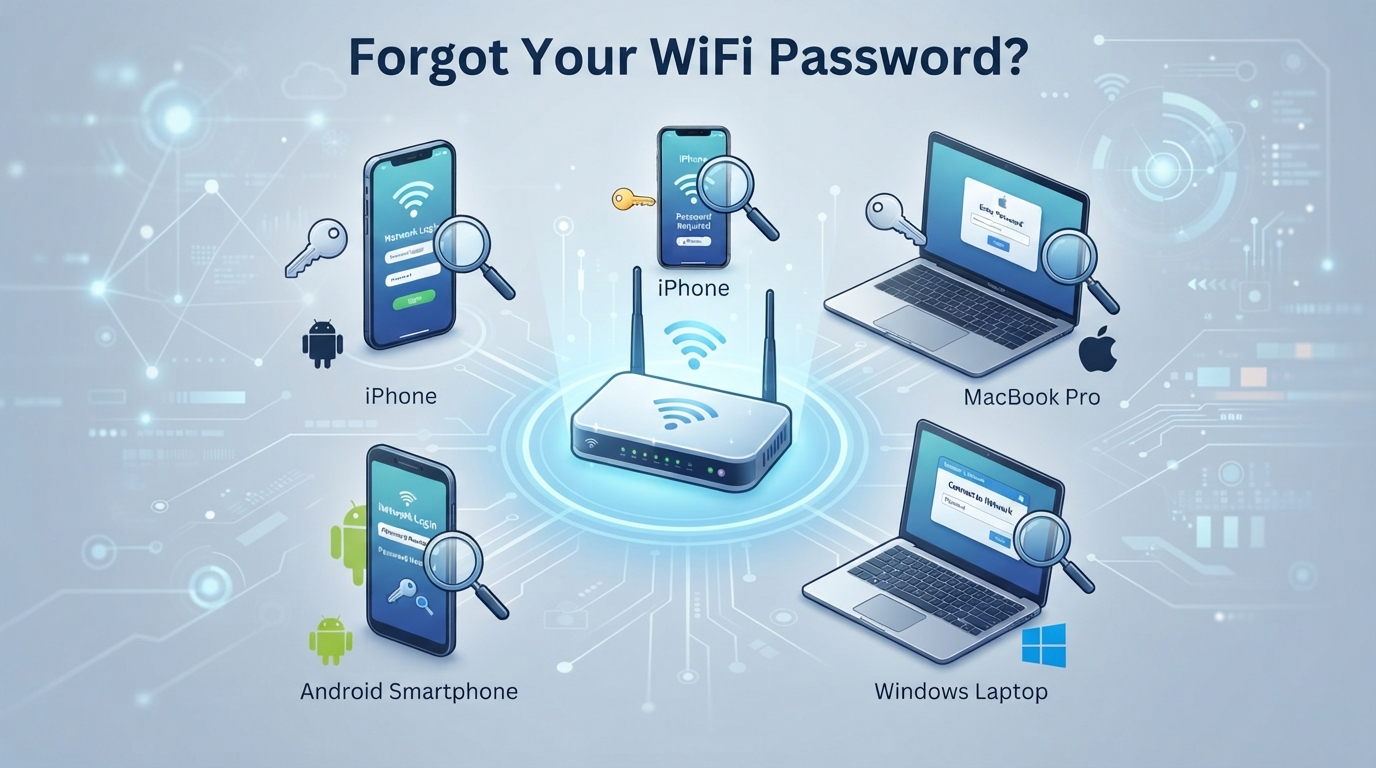
Your laptop says it is connected to Wi-Fi. The signal bars look normal. The network name is visible.
But when you open Chrome, Edge or another app, nothing loads.
Windows may show messages such as Connected, no internet, No internet, secured or simply display a network connection that does not actually reach the internet.
The good news is that this does not always mean your router is broken or that you need to call your internet provider.

“Connected” means the computer can communicate with the Wi-Fi network. It does not necessarily mean that the router can reach the internet.
First: Understand What “Connected, No Internet” Means
Wi-Fi and internet access are not exactly the same thing.
Your computer can successfully connect to your wireless router while the router itself has no working connection to your internet service provider.
Think of the connection as a chain:
Your PC
↓
Wi-Fi Adapter
↓
Router
↓
Modem / ISP Connection
↓
Internet
A failure anywhere in that chain can produce a “connected but no internet” message.

Testing each part of the connection helps identify whether the fault is inside Windows, the Wi-Fi router or the ISP.
1. Check Whether Other Devices Have Internet
Connect your phone, another laptop or tablet to the same Wi-Fi network.
If every device has no internet
The problem is probably not your Windows computer.
Possible causes include:
- Router or modem problem.
- ISP outage.
- WAN connection failure.
- Expired or suspended internet service.
- Router configuration problem.
If other devices work normally
The problem is probably isolated to your computer.
Continue with the Windows troubleshooting steps below.
2. Turn Wi-Fi Off and Back On
Open Windows Quick Settings, turn Wi-Fi off, wait several seconds, then turn it back on.
Reconnect to the network and test the internet again.
This simple step can clear temporary connection problems without changing more advanced settings.
3. Restart Your PC and Router
Restart the Windows computer first.
If the issue remains, restart the modem and Wi-Fi router.
Microsoft recommends restarting the modem and router because this creates a new connection to the internet service provider.
General restart procedure
- Turn off or unplug the modem/router.
- Wait a short period.
- Reconnect power.
- Allow the router to fully boot.
- Reconnect the PC to Wi-Fi.
4. Forget the Wi-Fi Network and Reconnect
A stored Wi-Fi profile can occasionally become problematic.
In Windows 11, go to:
Settings → Network & internet → Wi-Fi → Manage known networks
Select the affected network and choose Forget.
Then reconnect and enter the Wi-Fi password again.
5. Check VPN and Proxy Settings
A VPN or incorrect proxy configuration can make Windows appear connected while websites and applications fail to reach the internet normally.
Temporarily disconnect VPN software
If you are using a VPN, disconnect it temporarily and test the connection.
If internet access immediately returns, investigate the VPN application, server or configuration.
Check Windows Proxy
Go to:
Settings → Network & internet → Proxy
If you do not intentionally use a manual proxy, check whether a manual proxy has been enabled unexpectedly.
Microsoft specifically recommends checking manual proxy settings when troubleshooting a Wi-Fi connection that has no internet access.
6. Renew Your IP Address
Your router normally assigns an IP address to your computer using DHCP.
If that process fails, Windows may not communicate correctly with the local network.
Open Command Prompt as Administrator
Search for Command Prompt, right-click it and choose Run as administrator.
Then run:
ipconfig /release
ipconfig /renew
The first command releases the current IP configuration.
The second asks the network for a new IP address.
What Does a 169.254.x.x Address Mean?
Microsoft notes that an IP address beginning with 169.254 can indicate that Windows was unable to obtain an IP address from the router.
You can check the current address with:
ipconfig7. Flush the DNS Cache
DNS translates names such as example.com into IP addresses.
A stale or problematic DNS cache can sometimes cause websites to stop resolving even when the underlying network remains connected.
Run Command Prompt as Administrator and enter:
ipconfig /flushdnsThen close and reopen your browser and test again.
8. Reset Winsock and TCP/IP
If renewing the IP address and flushing DNS do not help, Microsoft recommends a broader set of network reset commands.
Run the following commands as Administrator:
netsh winsock reset
netsh int ip reset
ipconfig /release
ipconfig /renew
ipconfig /flushdns
Restart the PC afterward.
9. Test Whether DNS Is the Problem
Sometimes the internet connection itself is working but name resolution is not.
For example, Windows may be able to reach an IP address while failing to translate website names.
One simple diagnostic approach is to compare basic IP connectivity with domain-name access.
ping 1.1.1.1
ping microsoft.com
The result is not a perfect diagnostic on its own because some networks or servers may restrict ping traffic.
However, if IP-based connectivity works while domain names repeatedly fail, DNS becomes a stronger suspect.
10. Check the Wi-Fi Adapter in Device Manager
Open:
Device Manager → Network adapters
Locate your wireless adapter.
Typical names may include Intel Wireless, Realtek Wi-Fi, MediaTek, Qualcomm or another wireless adapter manufacturer.
Try disabling and enabling the adapter
- Right-click the Wi-Fi adapter.
- Select Disable device.
- Wait briefly.
- Enable it again.
Test the connection again.
11. Update or Reinstall the Wi-Fi Driver
If the connection stopped working after an update or driver change, the Wi-Fi adapter driver may be involved.
Microsoft recommends uninstalling the network adapter from Device Manager and restarting Windows if earlier steps fail.
Windows will then attempt to reinstall the adapter driver automatically.

If the problem affects only one computer, the Wi-Fi adapter or its driver becomes a stronger suspect.
General procedure
- Open Device Manager.
- Expand Network adapters.
- Right-click the wireless adapter.
- Select Uninstall device.
- Restart Windows.
- Allow Windows to reinstall the network adapter.
For manufacturer-specific systems, also check the support page for your exact laptop or motherboard model.
12. Use Network Reset as a Last Windows Step
If individual fixes have failed, Windows includes a broader network-reset option.
This should usually be one of the later steps rather than the first.
Network Reset removes and reinstalls network adapters and restores related networking settings to their defaults.
Try Ethernet to Isolate the Problem
If your computer has an Ethernet port, connect it directly to the router.
This is one of the best diagnostic tests available.
| Result | What It Suggests |
|---|---|
| Ethernet works, Wi-Fi does not | Wi-Fi adapter, driver, wireless settings or Wi-Fi signal problem |
| Neither Ethernet nor Wi-Fi works on the PC | Windows network configuration, VPN, proxy or broader PC issue |
| No device has internet | Router, modem or ISP problem |
| Only one website fails | The website or a DNS/browser-specific issue may be involved |
2.4 GHz vs 5 GHz: Try the Other Band
Many routers broadcast both 2.4 GHz and 5 GHz networks.
Microsoft recommends trying the other frequency band when troubleshooting Wi-Fi problems.
If your router presents them as separate network names, try switching between them.
Is It the Router or Your Computer?

| Test | Likely Conclusion |
|---|---|
| Phone and PC both fail | Check router / ISP |
| Phone works, PC fails | Check Windows / adapter |
| Ethernet works, Wi-Fi fails | Check wireless adapter / router Wi-Fi |
| Mobile hotspot works on PC | Your home router/network becomes a stronger suspect |
| Home Wi-Fi works on other devices | The affected PC becomes the main suspect |
What If Wi-Fi Says “No Internet, Secured”?
The word Secured generally refers to the wireless connection and its security.
It does not guarantee that the router has working internet access.
So you can be successfully authenticated to a secured Wi-Fi network while still having no path to the wider internet.
What If Internet Works on the Phone but Not the Laptop?
This is one of the most useful clues.
If the phone works normally on the exact same Wi-Fi network, concentrate on the laptop.
Check:
- Forget and reconnect to Wi-Fi.
- VPN.
- Proxy.
- IP address.
- DNS.
- Network commands.
- Wi-Fi adapter.
- Driver.
- Network Reset.
What If Nothing Works on Wi-Fi?
If phones, laptops, TVs and other devices all connect to the router but none can access the internet, Windows is probably not the main problem.
Check the modem/router status lights and whether the WAN or Internet indicator shows a fault.
Restart the equipment.
If the connection does not return, check your ISP's outage information or contact its support team.
What If Wi-Fi Works but Is Extremely Slow?
That is a different problem from having no internet at all.
Common areas to investigate include:
- Weak Wi-Fi signal.
- Distance from router.
- Congested 2.4 GHz channel.
- Too many connected devices.
- Background downloads.
- VPN performance.
- Router placement.
- ISP speed or congestion.
Fast Troubleshooting Order
Wi-Fi Connected → No Internet
↓
Test another phone or laptop
↓
Other devices also fail?
Yes → Restart router/modem → Check ISP
No → Continue on Windows PC
↓
Turn Wi-Fi off/on
↓
Forget network and reconnect
↓
Disable VPN / check Proxy
↓
Renew IP + Flush DNS
↓
Reset Winsock / TCP-IP
↓
Check Wi-Fi adapter and driver
↓
Try Ethernet
↓
Network Reset if necessary
Five Commands Worth Knowing
| Command | Purpose |
|---|---|
netsh winsock reset |
Resets the Winsock catalog |
netsh int ip reset |
Resets TCP/IP configuration components |
ipconfig /release |
Releases the current DHCP IP configuration |
ipconfig /renew |
Requests a new DHCP configuration |
ipconfig /flushdns |
Clears the local DNS resolver cache |
When Should You Contact Your ISP?
Contact the internet service provider when:
- Multiple devices cannot access the internet.
- The router shows an Internet or WAN fault.
- Restarting the router does not restore service.
- The connection repeatedly drops across all devices.
- Your ISP confirms an outage in your area.
- Your account or physical line may require service.
When Is It Probably a Windows Problem?
The Windows computer becomes the stronger suspect when:
- Every other device works normally.
- The PC works through a mobile hotspot but not your normal Wi-Fi.
- The problem began after a Windows or driver update.
- Ethernet works but Wi-Fi does not.
- The Wi-Fi adapter shows an error in Device Manager.
- Windows receives an abnormal local IP configuration.
Frequently Asked Questions
Why does Wi-Fi say connected but no internet?
Your PC may be connected successfully to the router while the router cannot reach the internet, or Windows may have an IP, DNS, proxy, VPN or network-adapter problem.
Why does the internet work on my phone but not my laptop?
If both devices use the same Wi-Fi network and only the laptop fails, the laptop's network configuration, adapter, driver, VPN, proxy or DNS configuration becomes more likely.
What does ipconfig /flushdns do?
It clears Windows' local DNS resolver cache so future domain-name lookups are performed again.
What does ipconfig /renew do?
It requests a new DHCP network configuration for the adapter.
What does a 169.254 IP address mean?
Microsoft says this usually indicates that Windows was unable to obtain an IP address from the router through DHCP.
Should I reset the router?
A normal restart is a good early troubleshooting step. A factory reset is much more disruptive and should not normally be the first action because it can erase your configured Wi-Fi and ISP settings.
Should I reinstall the Wi-Fi driver?
Try simpler steps first. If the problem affects only the PC and earlier troubleshooting fails, Microsoft recommends uninstalling the network adapter driver and restarting Windows so the driver can be reinstalled.
Does Network Reset delete my files?
It is intended to reset network adapters and networking settings rather than personal files, but you may need to reinstall or reconfigure networking software such as VPN clients afterward.
Final Takeaway
When Windows says Wi-Fi is connected but the internet does not work, do not immediately reinstall Windows or buy a new router.
First determine whether the problem affects one device or every device.
If all devices are offline, focus on the modem, router and ISP.
If only the Windows computer is affected, reconnect to the network, check VPN and proxy settings, renew the IP address and flush DNS.
If the problem continues, reset Winsock and TCP/IP, investigate the Wi-Fi adapter and driver, and use Network Reset only after the simpler fixes have failed.
The most important troubleshooting rule is simple: identify which part of the connection chain is failing before changing everything at once.
- Microsoft Support — Fix Wi-Fi connection issues in Windows
- Microsoft Support — Essential network settings and tasks in Windows
- Microsoft Support — Fix Ethernet connection problems in Windows
NewsHub note: Router interfaces, Wi-Fi adapter names and Windows menu locations can vary by device, Windows build and manufacturer. Avoid factory-resetting a router unless you know the ISP and Wi-Fi configuration required to restore it.