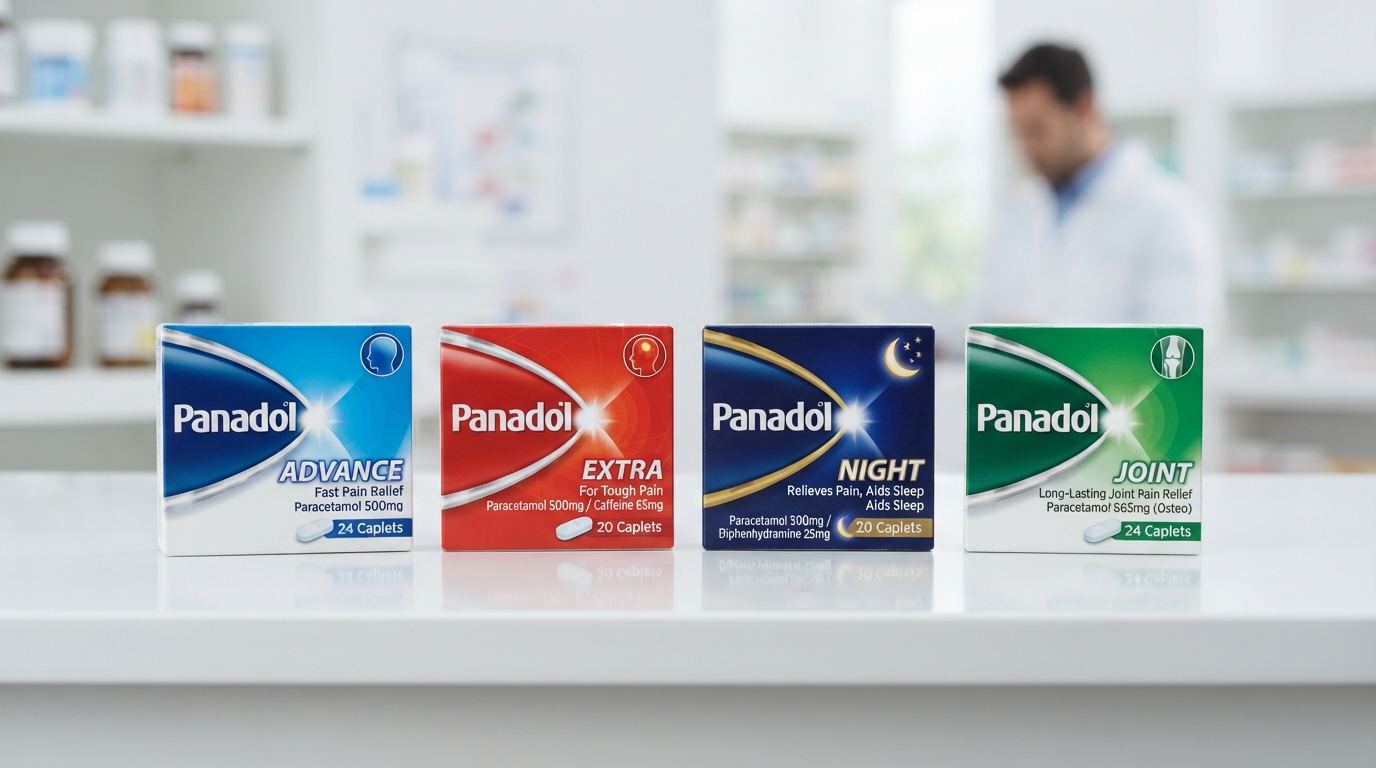
Walk into a pharmacy and ask for Panadol and you may be faced with far more choices than expected: Advance, Actifast, Extra, Night, Joint, Migraine, Sinus, Cold & Flu and several other versions.
The boxes may carry the same Panadol name, but they are not all the same medicine.
Some contain only paracetamol. Others combine paracetamol with caffeine, antihistamines, decongestants, aspirin or an antispasmodic. That means the most appropriate product depends on the symptoms being treated and on the person taking it.

Panadol products can contain different active ingredients, so the name on the front of the box is not enough to determine whether two products can safely be combined.
Panadol Types at a Glance
| Product | Active Ingredients | Main Role |
|---|---|---|
| Panadol Advance | Paracetamol 500 mg | Everyday pain and fever |
| Panadol Actifast | Paracetamol 500 mg | Fast pain relief formulation |
| Panadol Extra | Paracetamol 500 mg + Caffeine 65 mg | Tougher pain, particularly headaches and other common pains |
| Panadol Night | Paracetamol 500 mg + Diphenhydramine HCl 25 mg | Temporary night-time pain when pain is associated with difficulty sleeping |
| Panadol Joint | Paracetamol 665 mg sustained release | Longer-lasting relief, particularly osteoarthritis pain |
| Panadol Migraine | Paracetamol 250 mg + Aspirin 250 mg + Caffeine 65 mg | Migraine and certain minor aches and pains |
| Panadol Sinus | Paracetamol 500 mg + Pseudoephedrine HCl 30 mg | Sinus pain and nasal congestion |
| Cold & Flu Day | Paracetamol 500 mg + Caffeine 25 mg + Phenylephrine HCl 5 mg | Daytime cold and flu symptoms with congestion |
| Cold & Flu | Paracetamol 500 mg + Chlorpheniramine 2 mg + Pseudoephedrine HCl 30 mg | Cold and flu symptoms including congestion, sneezing and watery eyes |
| Cold & Flu Vapour Release | Paracetamol 600 mg + Phenylephrine HCl 10 mg | Hot-drink formulation for cold and flu symptoms with congestion |
| Cold & Flu All in One | Paracetamol 250 mg + Guaifenesin 100 mg + Phenylephrine HCl 5 mg | Cold and flu symptoms including chesty cough |
| Panadol Woman | Paracetamol 500 mg + Hyoscine butylbromide 10 mg | Period pain and abdominal cramps |
Product formulations and availability can differ between countries. The formulations above reflect the Panadol Middle East product information reviewed for this guide.
1. Panadol Advance — The Everyday Option
Panadol Advance is one of the simplest products in the range because its active medicine is paracetamol.
According to Panadol Middle East, each tablet contains 500 mg of paracetamol.
It can be used for short-term relief of headaches, toothache, muscular and musculoskeletal pain, period pain and symptoms associated with colds and flu. It can also reduce fever.

Advance, Actifast and Extra can look like similar pain-relief choices, but their formulations and intended advantages differ.
What Makes Advance Different?
The product uses the OPTIZORB formulation to enhance absorption compared with regular Panadol tablets.
2. Panadol Actifast — When Faster Absorption Is the Goal
Actifast also contains 500 mg of paracetamol per tablet, so the active pain-relieving ingredient is the same as in Panadol Advance.
The difference is in the formulation. Panadol says Actifast is absorbed twice as fast as regular Panadol tablets and is clinically shown to provide fast pain relief in as little as 15 minutes.
It is used for symptoms including headache, tension headache, migraine, toothache, muscle aches, period pain, and pain or fever associated with colds and flu.
3. Panadol Extra — Paracetamol Plus Caffeine
Panadol Extra is different from Advance because it combines paracetamol with caffeine.
Each tablet in the Middle East formulation contains 500 mg paracetamol and 65 mg caffeine.
It is marketed for relief of mild-to-moderate pain including headache, musculoskeletal pain, toothache, period pain, rheumatic pain and discomfort associated with colds and flu.
Why Add Caffeine?
Caffeine can act as an analgesic adjuvant, meaning it can enhance the pain-relieving effect in some situations, particularly headache treatment.
4. Panadol Night — Pain Relief Plus a Sedating Antihistamine

Night, Joint and Migraine are designed around very different needs and contain different formulations.
Panadol Night is not simply regular Panadol in a different package.
It contains 500 mg paracetamol plus 25 mg diphenhydramine hydrochloride, a sedating antihistamine.
It is intended for temporary relief of pain when that pain is associated with difficulty sleeping, including headache, migraine, backache, muscular and rheumatic pain, toothache, period pain and neuralgia.
5. Panadol Joint — Longer-Lasting Paracetamol
Panadol Joint contains 665 mg of paracetamol per tablet — more than the 500 mg found in many standard Panadol tablets.
More importantly, it uses a bi-layer design with an immediate-release component and a sustained-release component.
Panadol says this can provide pain relief for up to eight hours.
It is particularly positioned for mild-to-moderate osteoarthritis pain and muscle aches, although its official indications also include several other types of mild-to-moderate pain.
6. Panadol Migraine — Three Active Ingredients
Panadol Migraine is one of the most important products to distinguish from ordinary Panadol.
Each tablet contains 250 mg paracetamol, 250 mg acetylsalicylic acid — better known as aspirin — and 65 mg caffeine.
The product is marketed as an over-the-counter migraine treatment and is also indicated for temporary relief of several minor aches and pains.
7. Panadol Sinus — Pain Relief Plus a Decongestant

Cold and sinus products often contain additional medicines such as pseudoephedrine, phenylephrine or antihistamines.
Panadol Sinus combines paracetamol for pain and fever with pseudoephedrine, a nasal decongestant.
It is intended for temporary relief of sinus congestion and pain, nasal congestion, runny nose, headache, fever and body aches.
8. Panadol Cold & Flu Day
The Day formulation combines three ingredients.
Paracetamol targets pain and fever, phenylephrine is a nasal decongestant, and caffeine acts as an analgesic adjuvant and contributes to the daytime formulation.
It is used for cold and influenza symptoms including blocked or runny nose, headache, body aches and fever.
9. Panadol Cold & Flu
This version combines paracetamol with pseudoephedrine and chlorpheniramine, an antihistamine.
According to the official Middle East product information, it can relieve blocked or runny nose, headache, fever, body aches, sneezing and itchy or watery eyes.
10. Panadol Cold & Flu Vapour Release + Decongestant
This is a hot-drink powder formulation rather than a standard tablet.
Each sachet listed by Panadol Middle East contains 600 mg paracetamol and 10 mg phenylephrine hydrochloride.
It is intended for symptoms including blocked or runny nose, sore throat, headache, body aches and fever.
11. Panadol Cold & Flu All in One — When a Chesty Cough Is Part of the Problem
The key ingredient that distinguishes All in One is guaifenesin, an expectorant used for chesty cough.
The Middle East formulation combines 250 mg paracetamol, 100 mg guaifenesin and 5 mg phenylephrine hydrochloride per tablet.
It is indicated for short-term symptomatic relief of colds and influenza including chesty cough, sore throat, headache, body aches, fever and nasal congestion.
12. Panadol Woman — Period Pain and Cramping

Panadol Woman combines a pain reliever with an antispasmodic and is available only in certain markets.
Panadol Woman combines paracetamol with hyoscine butylbromide, an antispasmodic.
It is intended for cramps and pain associated with dysmenorrhea and period pain, and the official product information also lists cramping associated with irritable bowel syndrome.
Availability varies considerably by country, so travelers should not assume it is sold throughout the entire region.
So Which Panadol Is Used for Which Symptom?
Can You Take Two Different Panadol Products Together?
This is one of the most important questions in the entire guide.
You should not assume that two differently named Panadol products can be taken together.
Advance, Actifast, Extra, Night, Joint, Migraine, Sinus and the Cold & Flu range all contain paracetamol in the formulations discussed above.
Taking more than one can therefore unintentionally increase your total paracetamol dose.
Before Combining Any Pain or Cold Medicines
- Read the active ingredients, not just the brand name.
- Look specifically for paracetamol or acetaminophen.
- Check whether a cold or flu medicine already contains a painkiller.
- Do not exceed the dose on the product label.
- If unsure, ask a pharmacist before combining products.
Why Paracetamol Overdose Is Serious
Paracetamol is widely used and is generally considered safe when used correctly.
However, taking too much can cause severe liver injury.
One common way accidental overdose can happen is by taking several medicines without realizing that each contains paracetamol.
If an overdose is suspected, urgent medical attention is required even if the person initially feels well.
Who Should Be Extra Careful?
Medication suitability depends on the specific product, but extra care is particularly important for people with liver or kidney problems, people taking multiple medicines, pregnant or breastfeeding people, children, older adults, and anyone with conditions that may interact with decongestants, antihistamines, caffeine or aspirin.
For example, Panadol Migraine contains aspirin, Panadol Night contains a sedating antihistamine, and several sinus/cold formulations contain pseudoephedrine or phenylephrine.
These differences are why reading the leaflet matters.
What About Panadol for Children?

Children's medicines require age- and product-specific dosing. Never estimate a child's dose from an adult Panadol product.
Panadol Middle East also lists products specifically formulated for babies and children.
These are paracetamol products but their concentrations and dosing instructions differ from adult tablets.
Panadol Advance vs Extra: What Is the Difference?
Advance contains 500 mg paracetamol.
Extra contains 500 mg paracetamol plus 65 mg caffeine.
So Extra is not simply a higher dose of paracetamol. Its major difference is the addition of caffeine.
Panadol Advance vs Actifast
Both contain 500 mg paracetamol per tablet in the Middle East formulations reviewed.
Actifast is specifically formulated for faster absorption and contains sodium, while Advance uses the OPTIZORB formulation.
Panadol Extra vs Migraine
These are particularly important not to confuse.
Extra contains paracetamol and caffeine.
Migraine contains paracetamol, caffeine and aspirin.
That additional aspirin significantly changes the product's precautions and suitability.
Panadol Night vs Regular Panadol
Night contains diphenhydramine in addition to paracetamol.
The diphenhydramine is sedating, which is why the product is designed for temporary night-time pain when difficulty sleeping is also present.
It should not be viewed as ordinary paracetamol that happens to be marketed in a night-time box.
Frequently Asked Questions
Is every type of Panadol just paracetamol?
No. Many contain paracetamol, but several also contain caffeine, antihistamines, decongestants, aspirin, guaifenesin or hyoscine butylbromide.
What is the difference between Panadol Advance and Extra?
Advance contains 500 mg paracetamol. Extra contains 500 mg paracetamol plus 65 mg caffeine in the Middle East formulations reviewed.
What is Panadol Night used for?
It is intended for temporary relief of pain when pain is associated with difficulty sleeping. It contains paracetamol and sedating diphenhydramine.
Which Panadol is for sinus congestion?
Panadol Sinus combines paracetamol with pseudoephedrine and is intended for sinus pain and nasal congestion, but decongestants are not suitable for everyone.
Does Panadol Migraine contain aspirin?
Yes. The Middle East formulation contains paracetamol, acetylsalicylic acid (aspirin) and caffeine.
Can I take Panadol Extra and Panadol Night together?
Both contain paracetamol. Do not combine paracetamol-containing products unless a healthcare professional has confirmed how to do so safely.
Why is Panadol Joint different?
It contains 665 mg sustained-release paracetamol and uses a bi-layer formulation designed to provide longer-lasting pain relief.
Which Panadol is best?
There is no single “best” Panadol. Different products are formulated for different symptoms, and suitability depends on the person's health, age, other medicines and symptoms.
Final Takeaway
The most important thing to understand about Panadol is that the name on the box does not tell the whole story.
Panadol Advance and Actifast contain paracetamol alone in the formulations reviewed, while Extra adds caffeine, Night adds a sedating antihistamine, Migraine adds aspirin and caffeine, and the Sinus and Cold & Flu ranges introduce decongestants and other medicines.
That is why choosing a medicine should start with the active ingredients, not the color of the package.
And before taking two products together, always check whether both already contain paracetamol.
- Panadol Middle East — Adult Products.
- Panadol Middle East — Panadol Advance.
- Panadol Middle East — Panadol Actifast.
- Panadol Middle East — Panadol Extra with Optizorb.
- Panadol Middle East — Panadol Night.
- Panadol Middle East — Panadol Joint.
- Panadol Middle East — Panadol Migraine.
- Panadol Middle East — Panadol Sinus and Cold & Flu range.
- Panadol Middle East — Panadol Woman.
Medical disclaimer: This article is for general educational purposes and does not replace advice from a doctor or pharmacist. Product formulations, availability, age restrictions and instructions can differ by country. Always read the label and patient information leaflet for the exact product you have. Last reviewed: September 10, 2026.