Humanoid Robots Are Entering the Real World: Is 2027 the Beginning of the Robot Workforce?
Humanoid robots are moving beyond laboratory demonstrations. New industry data and factory programs suggest that AI-powered machines designed to operate in human environments are beginning a new phase of real-world testing and deployment.
Around 7,000 humanoid robots were sold worldwide during 2025 for industrial and professional service applications, according to data reported by the International Federation of Robotics. Although the number remains small compared with conventional industrial robots, humanoids are attracting rapidly growing attention from manufacturers, technology companies and AI developers.
Article Contents
- Why humanoid robots matter now
- The first real market numbers
- Robots are heading into factories
- Why AI changes robotics
- What could happen to jobs?
- Will humanoid robots enter homes?
- The biggest challenges
- What could happen by 2030?
- Humanoid robots vs industrial robots
- Frequently asked questions
- Conclusion
Why Are Humanoid Robots Suddenly So Important?
For decades, robots have worked inside factories. But most industrial robots were designed for one specific task and normally operated in controlled environments separated from people.
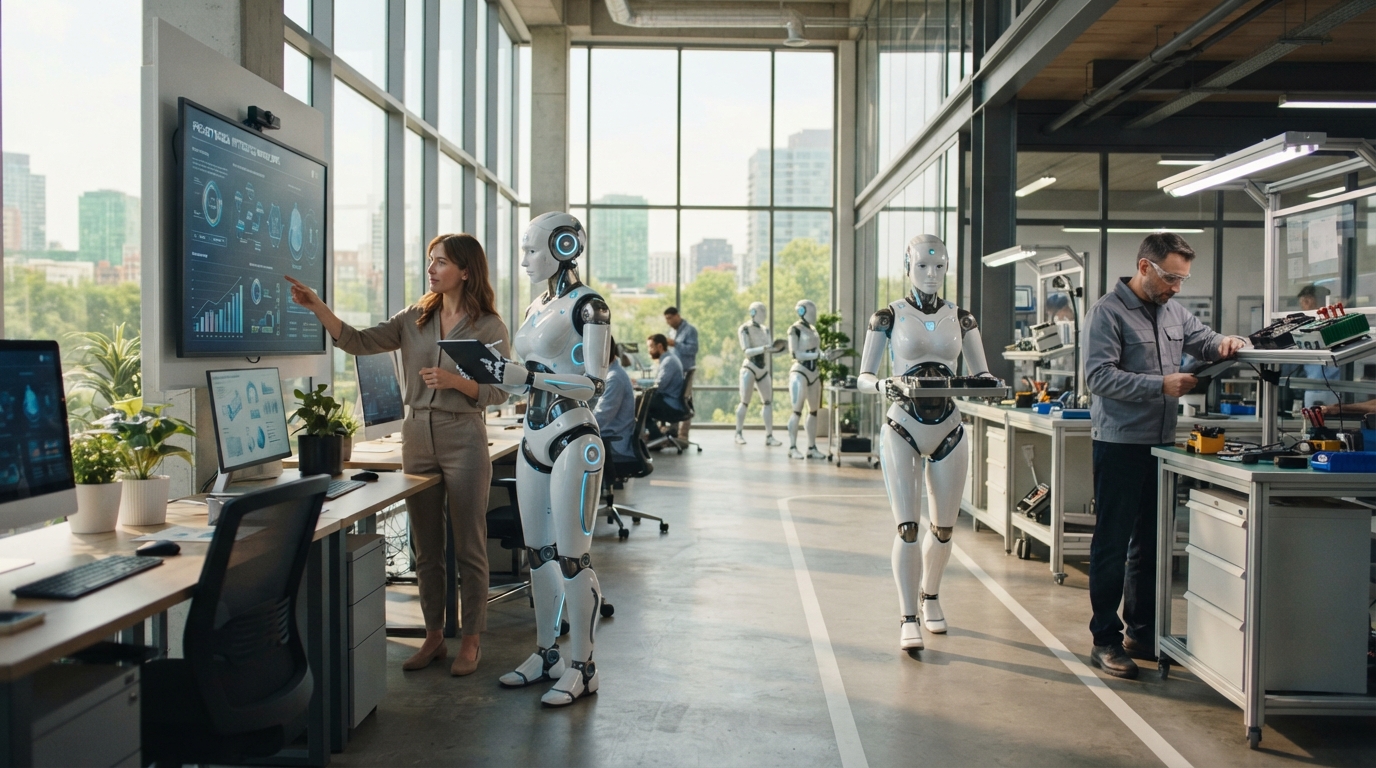
Humanoid robots represent a different idea. Their body structure and movement are designed to help them operate in environments originally built for humans.
Instead of redesigning an entire factory or workplace around a machine, companies hope that future humanoid robots could eventually use existing doors, tools, workstations and spaces.
Much of the physical world was designed around the human body. A robot capable of navigating those same environments could potentially perform a wider variety of tasks without requiring every workplace to be rebuilt.
The Humanoid Robot Market Is Beginning to Become Measurable
A significant milestone arrived when the International Federation of Robotics began including humanoid robots in its global robotics statistics.
According to IFR data reported in September 2026, approximately 7,000 humanoid robots were sold globally during 2025 for industrial and professional service applications.
That figure is still extremely small compared with the wider robotics market. Approximately 542,000 conventional industrial robots were installed during 2024, demonstrating how early the humanoid sector remains.
Many of the humanoid robots purchased during this early stage are also being used for research, AI development and pilot programs rather than operating as full replacements for human workers.
Seven thousand units may sound small, but the importance is that humanoid robots are beginning to move from prototypes and demonstrations toward a measurable commercial market.
Factories Could Be the First Major Test
Automotive manufacturing is emerging as one of the earliest environments for testing humanoid robots.
Car factories already have extensive experience with automation, making them logical testing grounds for robots capable of handling tasks in spaces designed for human workers.
Boston Dynamics, for example, has opened a testing facility connected with Hyundai Motor Group operations in Georgia to prepare its Atlas humanoid robot for automotive manufacturing tasks.
The goal of these programs is not simply to demonstrate that a robot can walk. The bigger challenge is proving that robots can perform useful physical work repeatedly, safely and economically.
The real breakthrough for humanoid robots will not be learning how to walk. It will be learning how to work reliably.
Artificial Intelligence Is Changing Robotics
The rapid development of artificial intelligence is one reason humanoid robots are attracting renewed attention.
Traditional robots generally follow carefully programmed instructions. Modern AI systems create the possibility of machines that can interpret more complex environments, recognize objects and adapt their actions.
This concept is sometimes described as physical AI: artificial intelligence that does not remain inside software but interacts directly with the physical world.
A capable humanoid robot may eventually need to combine computer vision, language understanding, movement planning, navigation, object manipulation and real-time decision making.
- Understand spoken or written instructions.
- Recognize objects and surroundings.
- Navigate human environments.
- Manipulate tools and materials.
- Learn from demonstrations and data.
- Adjust actions when conditions change.
What Could Humanoid Robots Mean for Jobs?
The effect of humanoid robots on employment is likely to depend heavily on how capable, reliable and affordable the technology becomes.
Early industrial deployments are focused on controlled tasks where automation could improve productivity or reduce exposure to repetitive, physically demanding or potentially dangerous work.
If the technology improves significantly, companies could eventually automate a broader range of physical tasks that previously required human flexibility.
Current humanoid robots remain an emerging technology. Demonstrations and pilot projects should not automatically be interpreted as evidence that large-scale replacement of human workers is imminent.
New technology can also create different types of work involving robot maintenance, fleet management, safety, training, software, supervision and integration.
Will Humanoid Robots Eventually Enter Our Homes?
A general-purpose household robot remains a much harder challenge than a robot operating inside a controlled factory.
Homes contain unpredictable environments, fragile objects, children, pets, stairs and thousands of different tasks. A consumer robot must also meet extremely demanding safety and cost requirements.
For this reason, industrial and professional environments are likely to remain important testing grounds while the technology develops.
However, advances in AI, sensors, batteries, motors and robotic manipulation could gradually make more capable service robots possible.
The Biggest Challenges Humanoid Robots Still Face
Building a machine that resembles a human is easier than building one that can safely and reliably perform useful human work for many hours.
- Battery life: Mobile robots need enough energy to operate for useful periods.
- Reliability: Industrial systems must repeat tasks consistently.
- Dexterity: Human hands remain extraordinarily difficult to reproduce mechanically.
- Safety: Powerful robots operating around people require strong safeguards.
- Cost: Robots must provide enough economic value to justify purchasing and maintaining them.
- AI reliability: Intelligent systems must respond appropriately to unexpected situations.
These challenges help explain why impressive demonstrations do not necessarily translate immediately into widespread commercial deployment.
Could 2027 Become a Turning Point?
The next several years will help determine whether humanoid robots become a major new computing platform or remain specialized machines used only in certain environments.
The combination of increasingly capable AI models, better sensors, improved robotics hardware and major corporate investment is accelerating experimentation.
The most important signal to watch is not the number of viral robot demonstrations. It is the number of robots that begin completing economically useful work reliably in real workplaces.
The humanoid robot race is shifting from “Can we build it?” toward “Can it perform useful work every day?”
If manufacturers successfully answer that question, the late 2020s could mark the beginning of a much larger market for intelligent physical machines.
Humanoid Robots vs Traditional Industrial Robots
| Feature | Traditional Industrial Robot | Humanoid Robot |
|---|---|---|
| Environment | Usually structured | Designed for human environments |
| Main Purpose | Specialized repetitive tasks | Potentially multiple tasks |
| Mobility | Often fixed | Designed to move between locations |
| AI Requirements | Often predefined programming | Increasing use of advanced AI |
| Commercial Maturity | Highly established | Early-stage market |
| Current Scale | Hundreds of thousands annually | Still comparatively small |
Frequently Asked Questions
What is a humanoid robot?
A humanoid robot is a robot designed with human-like physical characteristics so it can potentially operate in environments and perform tasks originally designed for people.
How many humanoid robots are being sold?
International Federation of Robotics data reported in September 2026 indicated that approximately 7,000 humanoid robots were sold worldwide during 2025 for industrial and professional service applications.
Where are humanoid robots being tested?
Early applications include research facilities and industrial pilot programs, particularly in manufacturing and automotive environments.
Will humanoid robots replace human workers?
It is too early to determine the long-term employment impact. Current systems remain relatively early in commercial development, and many deployments are still experimental or limited in scale.
Why does AI matter for humanoid robots?
AI can help robots interpret instructions, understand environments, recognize objects, plan movements and adapt to situations that cannot all be manually programmed in advance.
Could humanoid robots become common by 2030?
The market could expand substantially if manufacturers improve reliability, safety and economics. However, the scale and speed of adoption remain uncertain.
Conclusion
Humanoid robots are entering one of the most important stages in their development: the transition from impressive demonstrations toward practical real-world work.
The approximately 7,000 units reported for 2025 represent only a tiny part of the global robotics industry, but they provide evidence that a commercial humanoid market is beginning to emerge.
Artificial intelligence could accelerate this transition by giving robots better abilities to understand instructions, interpret environments and adapt their actions.
Major challenges remain, including cost, battery life, dexterity, safety and reliability. The success of humanoid robots will ultimately depend less on how human they look and more on whether they can perform useful work safely and economically.
That makes 2027 and the years approaching 2030 particularly important. The next stage of the AI revolution may not happen only on computer screens. It could increasingly take physical form.
International Federation of Robotics — World Robotics data and humanoid robot market statistics.
Reuters — Humanoid robot sales tally hit 7,000 globally in 2025, September 2026.
Boston Dynamics / Hyundai — Atlas humanoid robot industrial testing and manufacturing programs.