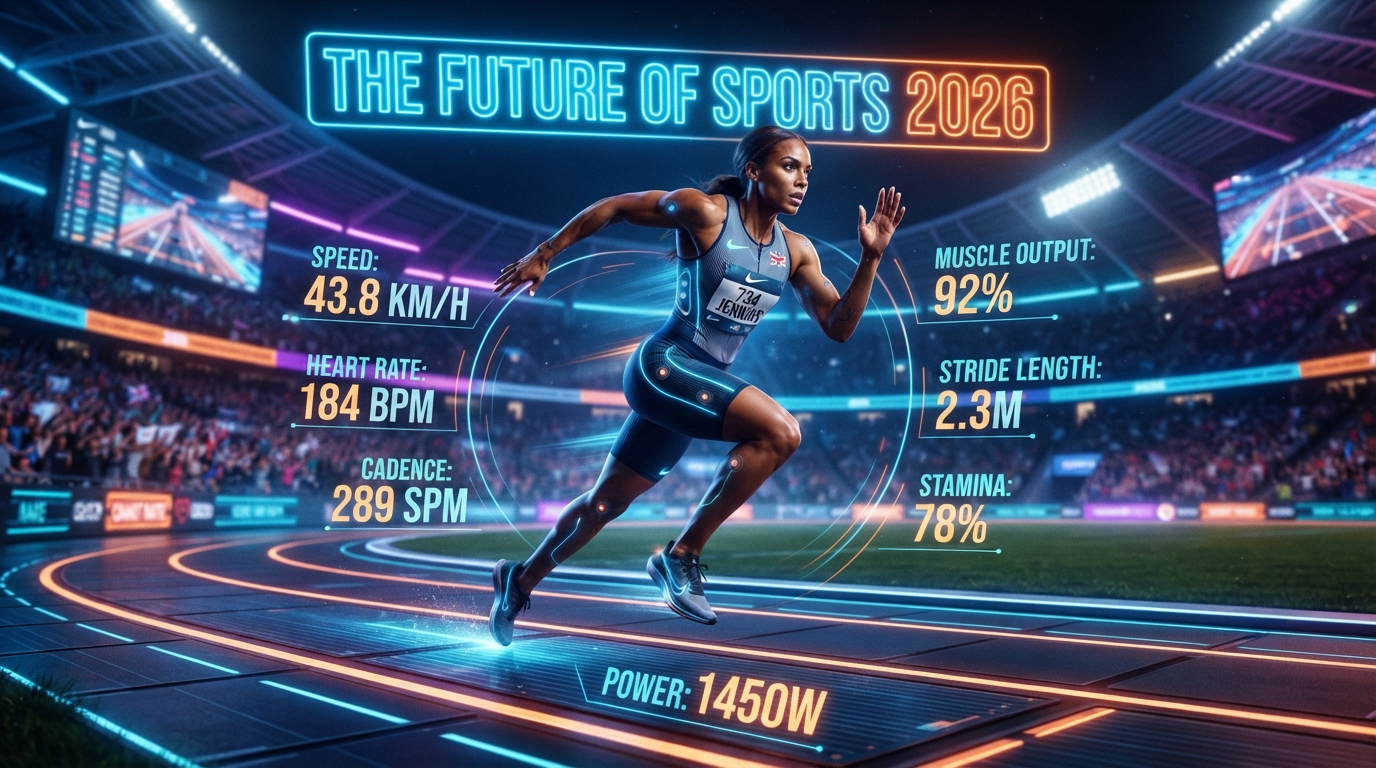
The Future of Sports Has Already Arrived
Sports are entering a completely new era.
For generations, athletes improved through training, experience, coaching and competition. Today, another powerful tool is changing the game: artificial intelligence.
AI is moving into professional sports, fitness training, wearable technology, performance analysis and everyday exercise.
The result is a new generation of sports technology that can collect information, analyze movement, identify patterns and help athletes understand their performance.
But this revolution is not only for professional athletes.
The same technologies are becoming increasingly accessible to ordinary people who want to run faster, train smarter, walk more, improve their fitness or simply understand their activity.
The future of sports may not be about training harder. It may be about training smarter.
Why Wearable Technology Is the Biggest Fitness Trend of 2026
The American College of Sports Medicine has named wearable technology the number one fitness trend for 2026.
This is a major signal for the fitness industry.
Smartwatches, fitness trackers, smart rings and other wearable devices are becoming part of everyday training and activity tracking.
These devices can collect information such as:
- Steps
- Distance
- Heart rate
- Workout duration
- Movement patterns
- Sleep information
- Training load indicators
- Recovery related measurements
The important change is that athletes are no longer relying only on how they feel during training.
They can also use data to understand what is happening inside their training routine.
Watch: The Evolution of Sports Technology
Modern sports content is increasingly showing how advanced training methods, data and technology are changing athletic preparation.
AI Is Becoming a New Training Partner
Artificial intelligence can process enormous amounts of information much faster than a human can manually analyze it.
In sports, this creates interesting possibilities.
An AI system can potentially analyze training data, movement information, workload patterns, recovery signals and performance history.
Instead of simply showing numbers, future systems may help explain what those numbers mean.
For example, an athlete may complete several training sessions during a week.
A traditional fitness tracker may simply display the activity.
An intelligent system could potentially identify changes in workload, recovery or performance and provide a more personalized interpretation.
AI and Wearables Are Changing Athlete Monitoring
Research published in 2026 has examined the combination of artificial intelligence and wearable technology in sports.
The research highlights potential applications including performance optimization, workload management, injury risk estimation, return to play support and athlete wellbeing.
However, researchers also emphasize that AI should be treated as a decision support tool rather than an unquestionable authority.
The quality of the data, the quality of the AI model and the expertise of coaches and professionals remain extremely important.
From Professional Athletes to Everyday People
You do not need to be an Olympic athlete to benefit from sports technology.
The same concept can be applied to everyday fitness.
A person who wants to become more active can use a smartwatch or smartphone to monitor daily movement.
A runner can track distance and pace.
A cyclist can monitor training information.
A gym user can record workouts.
A walker can track daily steps.
The technology creates something extremely valuable:
Feedback.
Feedback helps people understand whether their actions are moving them closer to their goals.
The Psychology of Seeing Your Progress
One reason fitness technology is powerful is that it makes invisible progress visible.
You may not notice that you are becoming more active from one day to another.
But after several weeks, your activity history can reveal a clear pattern.
You may discover that you walk more on certain days.
You may notice that your training becomes more consistent.
You may see that your running distance has increased.
Progress becomes something you can see.
Why Data Alone Is Not Enough
More data does not automatically create better athletes.
An athlete can have hundreds of statistics and still train incorrectly.
A runner can have an advanced smartwatch and still ignore recovery.
A gym user can track every workout and still lack a clear training plan.
Technology becomes useful when data is converted into better decisions.
This is where AI may become increasingly important.
The Rise of the AI Coach
One of the most exciting possibilities is the development of AI powered coaching systems.
An AI coach could potentially analyze an athletes training history and provide personalized suggestions.
For example:
- When to increase training intensity.
- When to reduce workload.
- How to structure a workout.
- How to maintain consistency.
- When recovery may be important.
- How to monitor long term progress.
Professional coaches will still play an important role, but AI could become an additional layer of analysis.
AI Could Change Running Forever
Running is one of the sports that can benefit significantly from data.
Runners already track distance, pace, heart rate and training volume.
AI could combine these signals and help athletes identify patterns that are difficult to see manually.
Future running systems may become increasingly personalized.
Instead of giving every runner the same training recommendation, an intelligent system could potentially adapt recommendations based on individual performance and recent activity.
Football Is Becoming More Data Driven
Football clubs around the world are increasingly using technology to analyze players and matches.
Tracking systems can provide information about player movement, distance, speed and positioning.
AI and advanced analytics can then help coaches understand patterns within large datasets.
This can support tactical analysis, player development and performance management.
Basketball Is Changing Too
Basketball is another sport where movement data can be extremely valuable.
Players constantly accelerate, stop, jump, change direction and move across the court.
Modern tracking technology can help capture these movements.
AI can potentially analyze the resulting information and identify patterns related to performance and workload.
AI and Injury Prevention
Injury prevention is one of the most interesting applications of sports technology.
Training too much without adequate recovery can create problems.
AI systems may help identify unusual patterns in training load or movement.
Researchers are studying whether these systems can contribute to earlier identification of potential risk patterns.
However, predictions should never be treated as guarantees.
Human expertise and professional assessment remain essential.
The Future of Recovery
Training is only one part of athletic performance.
Recovery is equally important.
Sleep, rest, nutrition, stress and training load can all influence performance.
Wearable devices can provide information related to some of these areas.
AI may eventually combine multiple signals to create more personalized recovery recommendations.
The Smart Gym Is Coming
The traditional gym is changing.
Connected equipment, mobile applications, wearable devices and AI systems are creating increasingly digital training environments.
Imagine entering a gym and having your training history automatically available.
Your previous workouts are already recorded.
Your progress is visible.
Your training plan can adapt.
Your equipment can connect to your digital profile.
This is the direction in which smart fitness technology is moving.
The New Athlete Is Data Aware
The athlete of the future will not necessarily be the person who owns the most expensive equipment.
The advantage will come from understanding how to use information correctly.
Knowing when to push.
Knowing when to recover.
Understanding progress.
Learning from previous training.
Using technology without becoming completely dependent on it.
Can Technology Make People More Active?
This may be one of the most important questions.
Technology can measure movement, but measurement alone does not guarantee behavior change.
People need motivation.
They need goals.
They need feedback.
They need a reason to continue.
Gamification and digital rewards can add another motivational layer to physical activity.
From Steps to Digital Rewards
Walking is one of the simplest forms of physical activity.
It can also be measured easily using smartphones and wearable devices.
This creates an interesting opportunity for digital fitness platforms.
Instead of simply counting steps, platforms can turn movement into challenges, achievements, communities and digital rewards.
The goal is to make physical activity more engaging.
Where Fitcoin Fits Into the New Sports Economy
Fitcoin is built around the idea of connecting physical activity with digital rewards.
The concept is simple: encourage people to move, track their activity and make the experience more rewarding.
This fits into a broader movement toward technology that connects digital experiences with real world behavior.
The future of fitness may not be only about tracking what people do.
It may also be about creating better reasons for people to keep doing it.
The Future of Competitive Sports
Competitive sports are becoming increasingly data driven.
Teams can analyze enormous amounts of information.
Athletes can monitor their bodies.
Coaches can study performance patterns.
Technology can provide new perspectives that were impossible to obtain in previous generations.
But competition will remain human.
Determination, discipline, teamwork, courage and mental strength cannot be replaced by a dashboard.
Human Intelligence and Artificial Intelligence
The most powerful sports teams of the future may combine human expertise with artificial intelligence.
Coaches understand context.
Athletes understand how their bodies feel.
AI can analyze enormous datasets.
Wearables can continuously collect information.
Together, these elements can create a much more complete picture of performance.
What Athletes Can Do Today
You do not have to wait for the future.
There are simple steps athletes and fitness enthusiasts can take today.
- Track your workouts consistently.
- Monitor your daily movement.
- Use wearable technology when it is useful for your goals.
- Review your progress every week.
- Pay attention to recovery.
- Avoid increasing training too quickly.
- Use AI for analysis and planning rather than blindly following every recommendation.
- Keep human judgment at the center of important decisions.
- Set realistic goals.
- Focus on consistency.
What Sports Could Look Like in 2030
By 2030, sports technology could look dramatically different.
Wearable devices may become smaller and more powerful.
AI coaching may become common.
Training environments may become increasingly connected.
Performance data may be analyzed almost instantly.
Fans may experience sports through immersive digital environments.
Athletes may have access to personalized technology that was previously available only to elite teams.
The boundary between sports, software and data will continue to disappear.
The Biggest Opportunity Is Not Technology
The biggest opportunity is behavior.
A perfect fitness tracker is useless if it stays in a drawer.
An advanced AI coach is useless if someone never trains.
A detailed performance dashboard is useless if the athlete does not act on the information.
Technology matters because it can help people take action.
Movement Could Become More Valuable
As digital technology becomes a larger part of daily life, physical movement could become even more important.
People spend increasing amounts of time interacting with screens.
Fitness technology creates a bridge between the digital world and the physical world.
A smartphone can encourage a person to walk.
A wearable can measure movement.
An AI system can analyze patterns.
A reward platform can make the experience more engaging.
This creates a completely different relationship between technology and physical activity.
Technology Should Help People Move More
The best fitness technology should not encourage people to sit in front of another screen all day.
It should encourage people to get up.
Walk.
Run.
Train.
Play.
Compete.
Explore.
And build healthier habits.
Trusted References
This article uses publicly available information and research from established sports and scientific organizations.
- American College of Sports Medicine - Top Fitness Trends for 2026
- ACSM Fitness Trends
- Frontiers in Artificial Intelligence - AI and Wearables in Sport
- Frontiers in Artificial Intelligence - Performance Enhancement in Elite Sport
- Frontiers in Physiology - AI and Athletic Performance Prediction
- YouTube - Modern Athletic Training
Final Thoughts
The future of sports is not simply about stronger athletes.
It is about smarter training.
Artificial intelligence, wearable technology, mobile applications and advanced analytics are changing the way athletes understand performance.
But the most important part of the equation remains human.
The athlete still has to train.
The runner still has to run.
The player still has to compete.
The person still has to take the first step.
Technology can measure your movement. AI can help you understand it. But you are the one who has to move.
The next generation of sports will belong to people who combine technology with discipline, consistency and a genuine desire to improve.
Start moving. Track your progress. Use technology wisely. And make every step count.
Discover Fitcoin and turn your movement into a more rewarding experience.