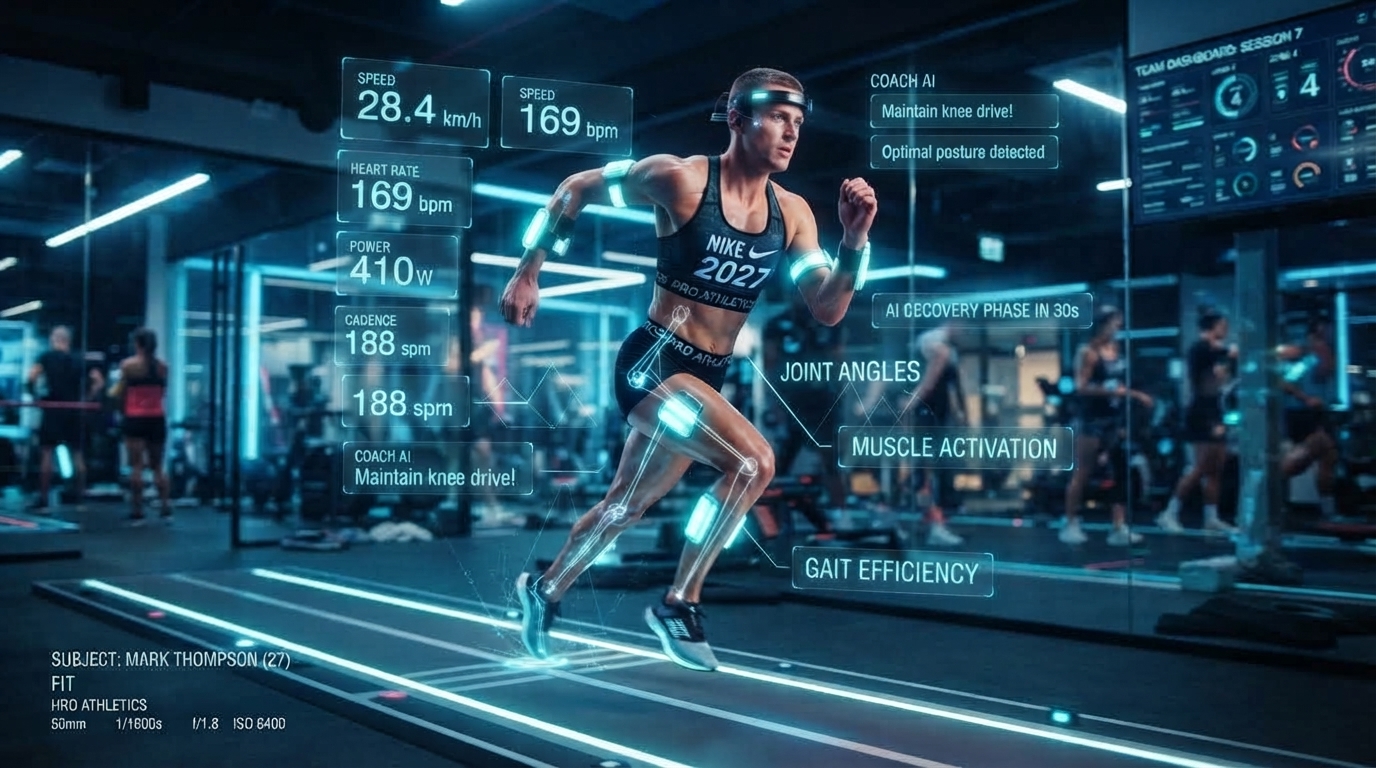
AI in Sports 2027: How Artificial Intelligence and Smart Wearables Are Changing Training
Artificial intelligence, smart wearables and real-time data analytics are rapidly changing how athletes train, recover and understand their performance. The next generation of sports technology could make personalized AI coaching available far beyond professional teams.
The sports industry is moving from simply collecting fitness data toward using artificial intelligence to interpret that information. Training load, movement, heart rate, recovery, sleep and other signals can increasingly be analyzed together to support more individualized decisions.
Article Contents
- Why AI is entering sports
- The rise of smart wearables
- The AI personal coach
- Can AI help reduce injury risk?
- AI and technology in football
- Personalized performance
- Recovery and sleep
- Privacy and limitations
- What sports could look like by 2030
- Sports technology comparison
- Frequently asked questions
- Conclusion
Why Is Artificial Intelligence Entering Sports?
Modern athletes generate enormous amounts of data. GPS trackers can measure movement and distance, heart-rate monitors can follow cardiovascular responses, inertial sensors can capture movement patterns, and wearable devices can monitor indicators related to sleep and recovery.
Collecting this information is only the first step. The bigger opportunity is understanding what thousands of data points may mean for an individual athlete.
Artificial intelligence and machine-learning systems can analyze complex datasets and identify patterns that may be difficult to detect manually. This is creating new possibilities for performance monitoring, workload management and personalized training.
Sports technology is gradually moving from telling athletes what happened during yesterday's workout toward helping them understand what they may need to do next.
The Rise of Smart Wearables
Smartwatches are only one part of the modern sports technology ecosystem. Athletes and teams can now use GPS trackers, heart-rate sensors, inertial measurement units, sleep trackers and specialized performance-monitoring systems.
These devices can continuously generate physiological, biomechanical and behavioral information. When analyzed appropriately, the data can help coaches and athletes understand how the body is responding to training.
- Heart rate and heart-rate variability monitoring.
- GPS-based speed, distance and workload tracking.
- Movement and acceleration analysis.
- Sleep and recovery monitoring.
- Training-load assessment.
- Performance trends over time.
The important development is not simply that wearables are becoming more capable. AI systems can increasingly combine multiple data streams rather than examining each measurement independently.
The Rise of the AI Personal Coach
One of the most interesting future applications is personalized AI coaching.
Traditional training programs often follow fixed schedules. An athlete may be told to complete a difficult workout on Tuesday regardless of how well they slept, how much fatigue they accumulated or how their body responded to the previous session.
An AI-assisted system could potentially take a different approach. It could analyze recent training load, recovery indicators, sleep information and performance trends before suggesting an appropriate training intensity.
The future of fitness may be less about following a fixed program and more about continuously adapting the program to the athlete.
For recreational athletes, this could eventually bring capabilities once associated mainly with professional sports science departments into consumer fitness devices and applications.
Can AI Help Reduce Sports Injury Risk?
Injury-risk assessment is one of the most actively researched applications of artificial intelligence in sport.
Researchers are studying how machine-learning models can analyze information such as external workload, previous injuries, physiological indicators, movement data and recovery measures to identify patterns associated with elevated injury risk.
Wearable sensors can provide continuous information that would be extremely difficult for a person to analyze manually across an entire team.
Current research does not support treating AI as an automatic injury predictor. Model accuracy depends heavily on data quality, athlete population, validation methods and context. Many existing models still require stronger external validation before they can be considered broadly reliable.
The most realistic role for AI is therefore decision support. Coaches, sports scientists and medical professionals can use data-driven indicators alongside clinical assessment and professional judgment.
Football Is Becoming a Technology Laboratory
Professional football provides one of the clearest examples of how technology is becoming integrated directly into competition.
At the FIFA World Cup 2026, connected-ball technology uses an inertial measurement unit inside the official match ball to provide precise information about ball movement and player contact.
The system works together with dedicated stadium tracking cameras monitoring players and the ball. This information can support officials while also demonstrating how much real-time data modern sporting environments can generate.
The modern football match is increasingly becoming a live data environment in which the movement of players and even the ball itself can be digitally measured and analyzed.
Similar technologies could continue expanding into coaching, tactical analysis, broadcasting and fan experiences during the coming years.
Training Could Become Truly Personalized
Two athletes can complete exactly the same workout and experience very different physiological responses.
Fitness level, training history, age, previous injuries, recovery, sleep and many other factors can influence how an athlete responds to exercise.
This makes personalization one of the most promising applications of AI in sport.
Instead of relying only on generalized training plans, AI-assisted systems could continuously compare an athlete's current condition with their own historical information.
- Analyze recent workload.
- Evaluate available recovery indicators.
- Compare current performance with historical patterns.
- Identify unusual changes or trends.
- Support adjustments to training intensity or volume.
Recovery and Sleep Could Become Part of the Training Plan
Training is only one part of athletic performance. Recovery between sessions can be equally important.
Modern wearable devices can provide indicators related to sleep duration, heart-rate variability and recovery. AI systems may help combine these measurements with training history to build a broader picture of athlete readiness.
This could change how training programs are designed. Rather than viewing recovery as time away from training, future systems may treat recovery as an active component of the training process.
Wearable measurements are indirect indicators. They should not be treated as medical diagnoses or substitutes for professional assessment.
The Privacy Challenge
The growth of AI-powered sports technology also creates important questions about data ownership and privacy.
Wearable devices can collect highly personal information about an athlete's physical condition, sleep, location, movement, workload and recovery.
For professional athletes, this raises important questions. Who owns the data? Who can access it? Can clubs share it? How long should it be stored? Could performance data affect contracts or player evaluations?
As sports technology develops, responsible data governance, transparent algorithms and clear consent processes will become increasingly important.
What Could Sports Look Like by 2030?
No one can predict exactly how quickly sports AI will develop, but current research points toward increasingly personalized, multimodal and explainable systems.
Future platforms could combine information from several sensors and use athlete-specific historical data to provide more contextual recommendations.
Possible developments include AI-assisted training plans, automated movement analysis, real-time workload alerts, smarter recovery recommendations and more sophisticated digital models of individual athletes.
The biggest sports technology race may not be about collecting more data. It may be about turning the right data into better decisions.
The most successful systems are likely to keep humans involved. Coaches, doctors, physiotherapists and athletes provide context and judgment that an algorithm cannot automatically replace.
How AI Could Transform Sports Training
| Technology | What It Measures or Analyzes | Potential Use |
|---|---|---|
| GPS Wearables | Speed, distance and movement | Training-load monitoring |
| Heart-Rate Sensors | Cardiovascular response | Intensity and recovery analysis |
| IMU Sensors | Acceleration and body movement | Biomechanical analysis |
| Sleep Wearables | Sleep and recovery indicators | Readiness monitoring |
| AI Models | Multiple data sources | Pattern detection and decision support |
| Connected Sports Equipment | Ball or equipment movement | Performance and match analysis |
Frequently Asked Questions
How is AI used in sports?
AI can be used to analyze athlete data, monitor training load, study performance patterns, support injury-risk assessment and help coaches make more informed decisions.
Can AI prevent sports injuries?
AI cannot guarantee that an injury will be prevented. Research suggests it can help identify patterns associated with injury risk, but results depend on data quality, model validation and professional interpretation.
What sports wearables are used by athletes?
Common technologies include GPS trackers, heart-rate monitors, inertial measurement units, smartwatches and devices that monitor sleep or recovery-related indicators.
Will AI replace sports coaches?
Current evidence supports using AI primarily as a decision-support tool. Human coaches remain essential for strategy, communication, context, motivation and professional judgment.
Why could AI sports technology become a major trend?
Wearable devices are generating increasingly detailed data while AI systems are becoming better at analyzing complex information. Combining these technologies could make personalized sports analytics more accessible.
What could change by 2030?
Athletes may have access to more adaptive training systems that combine workload, movement, performance and recovery information to provide increasingly individualized recommendations.
Conclusion
Artificial intelligence is beginning to change the relationship between athletes and their performance data.
Wearables have already made it possible to continuously collect information about movement, workload, heart rate and recovery. The next phase is using AI to transform those measurements into useful and increasingly personalized insights.
The technology still has important limitations. Injury predictions require stronger validation, wearable measurements need context, and athlete data must be protected responsibly.
But the direction is significant. The future of sports training may not simply involve working harder. It could increasingly involve understanding when to train, how intensely to train, when to recover and how each athlete responds differently.
By 2030, the most valuable coach may not be AI alone or humans alone, but a combination of human expertise and intelligent technology working together.
Frontiers in Artificial Intelligence — Artificial intelligence and wearables in sport: performance, injury risk, and wellbeing (2026).
PubMed / Annals of Medicine — Artificial intelligence and wearable sensors in sports injury risk prediction: current status and future perspectives (2026).
FIFA — Connected Ball Technology, FIFA World Cup 2026.
Journal of Functional Morphology and Kinesiology — Injury Prediction and Risk Modelling in Team Sports Using Artificial Intelligence and Sensor-Based Monitoring (2026).