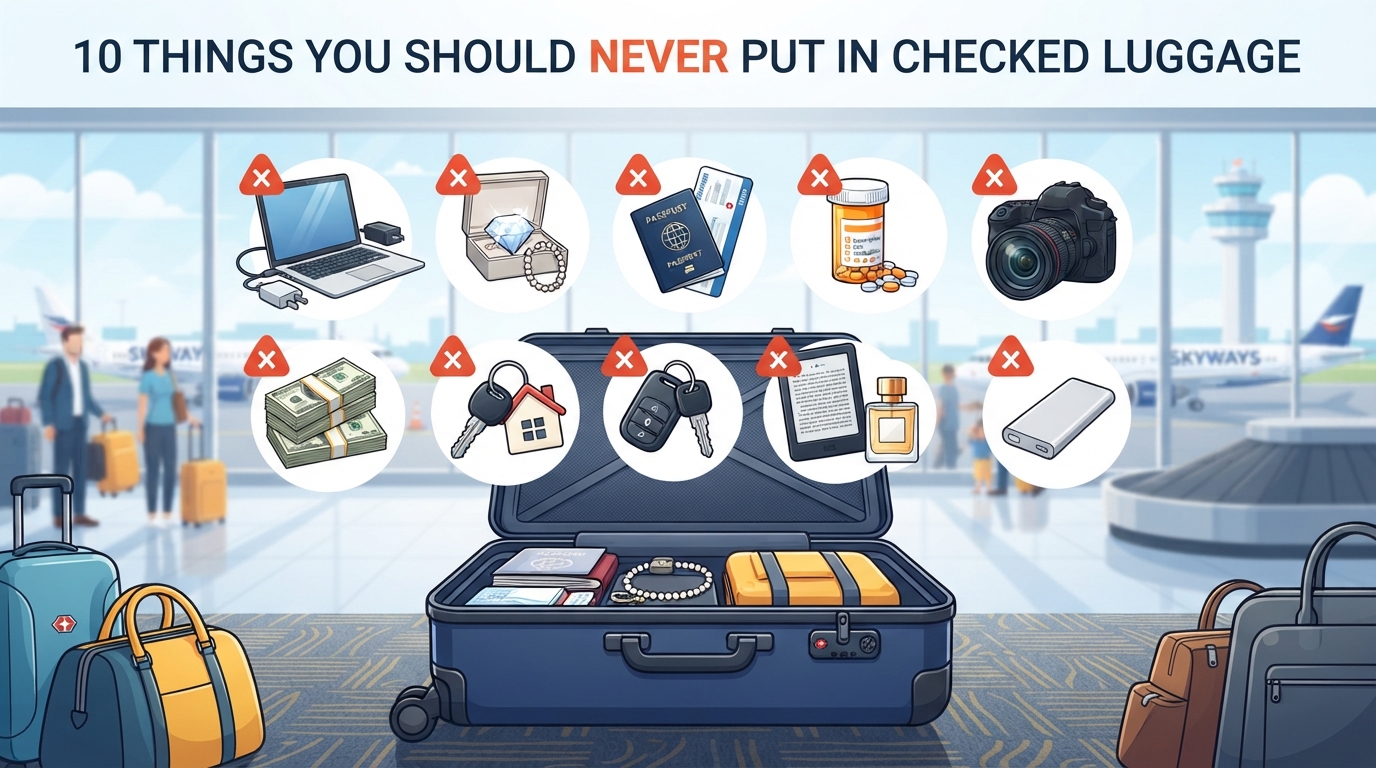
Checking a suitcase can make flying easier, but some belongings should never disappear into the aircraft hold with your clothes.
Some items are restricted from checked baggage for safety reasons. Others are technically permitted in many circumstances but are much safer, smarter or more convenient to keep with you in the cabin.

What you put in your carry-on can matter just as much as what you pack in your suitcase.
1. Power Banks
Keep them in your carry-on.
Power banks are treated as spare lithium batteries and should not be placed in checked baggage.
IATA states that power banks and spare batteries must be carried in hand baggage. FAA rules similarly prohibit spare lithium batteries and portable rechargers from checked baggage.
The reason is fire risk. A damaged or short-circuited lithium battery can overheat, and a problem is easier for trained crew to identify and respond to when the battery is accessible in the cabin.
2. Spare Lithium Batteries
Spare batteries belong in your carry-on.
This includes many spare batteries for cameras, laptops and other rechargeable devices.
FAA guidance states that spare lithium metal and lithium-ion batteries must be carried in cabin baggage and protected against damage and short circuits.
Battery terminals can be protected by keeping batteries in their original packaging, covering exposed terminals or placing batteries in an appropriate protective case.
Battery size also matters. Under U.S. FAA guidance, rechargeable lithium batteries up to 100 Wh are generally allowed for passenger use, while certain batteries from 101 to 160 Wh require airline approval. Larger batteries face stricter restrictions.
3. Your Passport and Important Travel Documents
Keep your passport, identification and essential travel documents with you.
Unlike a power bank, this is primarily a practical rule rather than a lithium-battery safety restriction.
If your checked bag is delayed, misrouted or unavailable when you need to pass immigration, having your passport inside it can create a serious problem.
Keep passports, visas, identification, boarding information and other essential documents in a secure and easily accessible part of your personal item or carry-on.
4. Essential Medication
Do not rely on your checked suitcase for medicine you may need during the journey.
Baggage can be delayed. Flights can also be disrupted, rerouted or extended.
Keeping essential medication with you helps ensure you can access it when needed.
Medication rules can vary by destination, particularly for controlled medicines, liquids, needles and refrigerated medication. Check the requirements of your airline and destination before traveling.
5. Cash, Cards and Valuable Jewelry
Keep high-value and difficult-to-replace belongings with you.
IATA recommends that valuable or irreplaceable items should not be placed in checked baggage.
That makes sense for cash, important cards, valuable jewelry and similar belongings.
Your checked suitcase passes through several stages between check-in and baggage claim, and you cannot access it during most of the journey.
6. Laptops, Cameras and Important Electronics
Carry important electronics in the cabin whenever possible.
Current IATA passenger guidance advises travelers to keep phones, laptops, cameras and other lithium-powered devices in hand baggage.
FAA guidance also recommends carrying devices containing lithium batteries in carry-on baggage.
Rules for a device with an installed battery are not identical to the rules for a spare battery. Under FAA rules, some battery-powered devices can be checked if they meet applicable limits, are completely powered off and are protected from damage and accidental activation.
But keeping expensive electronics in the cabin also reduces the risk of impact damage and keeps them accessible.
7. Keys
Your house and car keys are small enough to keep with you.
Imagine arriving at your destination while your suitcase travels somewhere else — with your house or car keys inside.
Keys are not generally prohibited from checked luggage, but putting your only set in a checked suitcase creates an unnecessary risk.
Keep them securely in your personal item instead.
8. Irreplaceable or Sentimental Items
If losing it would be devastating, think twice before checking it.
Family photographs, unique gifts, original documents and sentimental objects may have little financial value but enormous personal value.
IATA specifically advises passengers not to put valuable or irreplaceable items in checked baggage.
If an item cannot realistically be replaced, carrying it with you is usually the safer choice, provided it is permitted through security and by your airline.
9. Items You Need During the Flight or Immediately After Landing
Pack for the possibility that your checked bag arrives later than you do.
Useful carry-on items can include prescription glasses, contact-lens essentials, chargers, basic toiletries within applicable security limits and anything you genuinely need during the first hours of your trip.
For longer journeys, some travelers also keep a change of clothes in their carry-on.
The goal is not to move your entire suitcase into the cabin. It is to make sure a delayed checked bag does not immediately ruin your trip.
10. E-Cigarettes and Vaping Devices
Where permitted, these must not go in checked baggage.
FAA rules require electronic cigarettes and vaping devices carried by passengers to remain on the person or in carry-on baggage and to be protected against accidental activation.
However, legality varies significantly between countries. Some destinations prohibit or tightly regulate possession of vaping products regardless of airline baggage rules.
Always check both your airline policy and the laws at your destination before traveling with one.
Checked Bag or Carry-On? Quick Guide
| Item | Best Place | Why? |
|---|---|---|
| Power bank | Carry-on only | Lithium battery safety rules |
| Spare lithium batteries | Carry-on only | Lithium battery safety rules |
| Passport | Carry-on / personal item | Must remain accessible |
| Essential medication | Carry-on | Needed if baggage is delayed |
| Cash and valuables | Carry-on / personal item | Reduce loss risk |
| Laptop and camera | Prefer carry-on | Battery, access and damage considerations |
| Keys | Personal item | Difficult to manage if baggage is delayed |
| Irreplaceable items | Carry-on if permitted | Cannot easily be replaced |
| Immediate essentials | Carry-on | Available during delays |
| E-cigarette / vape | Carry-on where legal | Not permitted in checked baggage under applicable aviation rules |
What About a Phone or Laptop With the Battery Installed?
This is where the rules are often misunderstood.
A laptop containing its normal installed lithium battery is different from a loose spare laptop battery.
FAA guidance says devices containing qualifying lithium batteries should be carried in the cabin. If certain devices are placed in checked baggage, they must be completely switched off and protected from accidental activation and damage.
Spare lithium batteries and power banks, by contrast, are prohibited from checked baggage.
What About Smart Luggage?
Smart suitcases can contain batteries that power tracking, charging, digital scales or other features.
Battery rules therefore matter.
FAA guidance states that baggage equipped with lithium batteries generally must be carried in the cabin unless the battery is removed, subject to limited exceptions for very small integrated batteries.
If the battery is removable and the suitcase is checked, the removed battery must be carried according to the rules for spare batteries.
What If Your Carry-On Is Gate Checked?
This is an easy mistake to make.
You may arrive at the gate expecting to carry your bag into the cabin, only to be told that it must go into the hold because overhead space is limited.
FAA and IATA guidance says spare lithium batteries and power banks should be removed before the bag is gate checked.
This is one reason it helps to keep batteries and important documents in a part of your bag that you can access quickly.
One Rule That Can Prevent Many Travel Problems
Those essentials generally belong in your carry-on, provided security and airline rules allow them.
Always Check Your Airline Before Flying
International standards provide a useful baseline, but baggage policies are not identical everywhere.
IATA notes that airlines set baggage rules and that requirements can vary by route, ticket, airline and applicable regulation.
Some airlines can impose restrictions stricter than the general regulatory baseline.
If you are carrying unusual batteries, medical equipment, smart luggage or another item you are unsure about, check directly with the airline before arriving at the airport.
Frequently Asked Questions
Can I put a power bank in checked luggage?
No. Power banks are treated as spare lithium batteries and must be carried in hand baggage under IATA and FAA guidance.
Can I put a laptop in checked luggage?
Keeping it in carry-on baggage is recommended. Rules for devices with installed batteries can permit checked carriage under certain conditions, including complete power-off and protection from damage, but airline-specific restrictions should always be checked.
Can I put medicine in checked luggage?
Rules depend on the medicine and destination, but essential medication is generally smarter to keep accessible in your carry-on in case your checked baggage is delayed.
Can I put spare batteries in checked luggage?
Spare lithium batteries are prohibited from checked baggage and must be appropriately protected in carry-on baggage.
Can I put valuables in checked luggage?
IATA recommends that valuable or irreplaceable belongings should not be placed in checked baggage.
What happens if my carry-on is checked at the gate?
Remove spare lithium batteries and power banks before the bag goes into the aircraft hold. Keep important documents, medication and other essentials with you as well.
The Bottom Line
Packing smart is not just about saving space.
Power banks and spare lithium batteries belong in the cabin, while important documents, medication, valuables and irreplaceable belongings are usually much safer kept with you.
The distinction is important: some items are restricted from checked baggage by aviation safety rules, while others simply should not be checked because losing access to them could seriously disrupt your trip.
Before every flight, check the latest requirements from your airline and the authorities relevant to your route.